Opinion  August 12, 2026  Annah Otis

Summer Heat Sparks Staffing Concerns in European Museums

WikiCommons

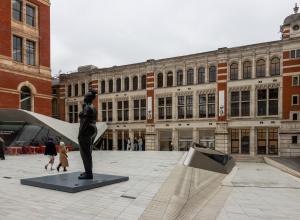
Victoria and Albert Museum in London. License.

Staff at both the Victoria and Albert Museum (V&A) and Royal Museums Greenwich (RMG) voted to strike over pay and working conditions in late July as European cities recover from a record-breaking heatwave that put long-standing employee concerns in the spotlight. Questions about how prepared many European museums are to withstand extreme climatic events are being raised.

More than 300 workers across four V&A sites cast ballots over claims of limited access to drinking water during 100-degree days, alongside ongoing complaints about pay and conditions. The Public and Commercial Services Union’s demands to leadership included closure of public galleries whenever temperatures exceed 30 degrees Celsius (86 degrees Fahrenheit), heat mitigation measures for staff working behind the scenes, and allowances for employees at the V&A East Storehouse to carry and drink water while stationed near objects on display. Food and drink are typically barred near collection items in museums to protect centuries-old artworks.

Commenting on the dispute, a V&A spokesperson said:

"The safety and wellbeing of our staff is of utmost importance to the V&A – all our staff have always had access to water and toilet facilities and regular breaks while at work. At V&A East Storehouse we have water fountains on every floor to ensure both staff and visitors in Front of House areas have access to drinking water throughout the building. To ensure the safety and security of national collections, during visits to V&A East Storehouse, food and drink are not permitted for visitors or staff in the main Collections Hall or storage areas. Extensive measures were implemented to support our staff during the heatwave, ranging from additional rest breaks, increasing staff rotations across gallery spaces, closing several galleries at V&A South Kensington and closing Young V&A during the peak of the heatwave.The V&A has been in negotiations with the trade union side since February and those negotiations are ongoing. Our offer sees a 3.6% increase in the overall pay bill, an above inflation pay award as a minimum, and 6.9% increase for our lowest paid colleagues. As always, we have maintained our long-standing commitment to paying at least the London Living Wage."

WikiCommons

V&A East Storehouse in Stratford, London. License.

Members of the Prospect union at V&A’s East Storehouse have already secured a partial win without striking. The museum agreed to grant two paid 15-minute breaks per day to better accommodate toilet and water needs. However, broader pay demands remain unresolved, including a call for the V&A to become an accredited London Living Wage employer to ensure that even outsourced contractors are paid the current London living wage of £14.90 ($20.10) per hour. Dates for a strike over these complaints have not yet been announced.

Staff at the four RMG institutions in London—the National Maritime Museum, the Queen’s House, the Royal Observatory, and the Cutty Sark—claimed August 11 and 12 for their own strike. It is intended to put pressure on leadership around wages, Christmas closures, fixed-term contract policies, and training pathways.

Temperatures (and tempers) are already high after a heat dome settled over Europe and pushed museums to confront the changing climate. Only about 20% of homes across the continent have air conditioning versus closer to 90% in the United States. Even major institutions like the Louvre are unable to cool their halls. The Eiffel Tower closed early on several days during the heatwave, while the Palais de Tokyo shut its doors entirely. Despite having temperature-controlled cases for artifacts, the British Museum does not have air conditioning across the building as a whole. Meanwhile, at the National Museum of the History of Immigration in Paris, entrance fees were waived and visitors flocked to its chilled galleries.

WikiCommons

Exterior of the National Maritime Museum, part of the Royal Museums Greenwich. License.

A 2022 survey of 578 museums by the Network of European Museum Organisations found that most of the continent’s institutions remain unprepared for a warming climate. More than half lack climate-friendly energy systems, and fewer than 10% have studied how rising temperatures might impact their buildings or collections. The V&A and RMG disputes suggest that extreme heat effects will fall hardest on the people staffing the galleries, in addition to the objects inside them. As heatwaves become a fixture of British summers, museum workers are making clear that protecting art is important, but so is protecting those who steward it.

About the Author

Annah Otis

Annah Otis is a New York City-based contributor to Art & Object with a master’s degree in art history. She is also a marketing communications executive.

Subscribe to our free art newsletter!

Webform
Art and Object Marketplace - A Curated Art Marketplace